Parents today are noticing a major shift in how children respond to quiet time, waiting, or moments without stimulation. The topic of child boredom tolerance decline has become increasingly important as more children struggle to stay calm without screens, constant entertainment, or structured activities. This change is closely linked with modern parenting trends and the growing concern around attention span kids face in fast-paced digital environments.
Earlier, boredom was often considered a normal part of childhood. Children created games, explored imagination, and learned patience during unstructured time. However, today’s children are surrounded by instant entertainment, quick rewards, and continuous stimulation. This has contributed significantly to the rise of child boredom tolerance decline, making boredom feel uncomfortable instead of creative.
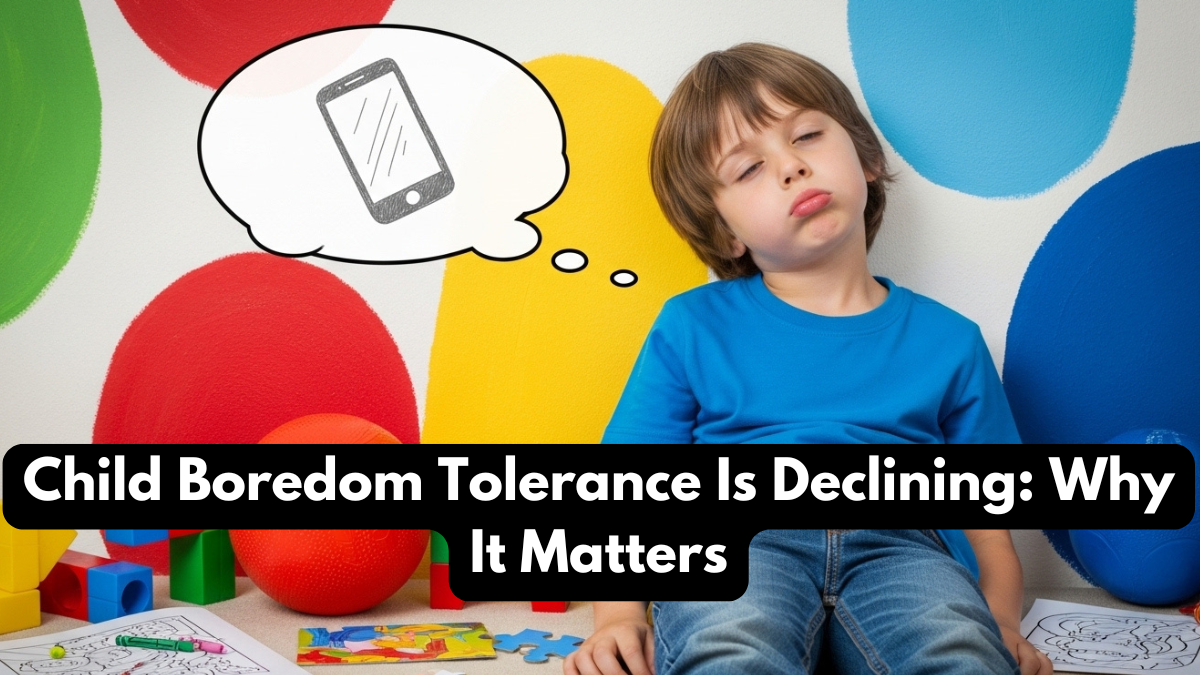
Why Child Boredom Tolerance Is Declining
The main reason behind child boredom tolerance decline is the constant availability of stimulation. Mobile phones, tablets, television, short-form videos, and heavily scheduled routines leave very little room for silence or self-created play. Many current parenting trends also focus on keeping children continuously engaged, often with good intentions.
When children are always entertained, they may not develop the ability to sit with boredom and find solutions independently. This directly impacts attention span kids need for school, reading, problem-solving, and emotional patience. Boredom actually helps the brain practice focus, creativity, and self-regulation.
Another reason is that parents themselves often feel pressure to prevent boredom. Many believe that an idle child means poor parenting, while in reality, boredom can be a powerful developmental tool. Understanding this shift in parenting trends is essential to reversing the pattern of child boredom tolerance decline.
How Boredom Supports Healthy Child Development
Boredom is not a problem—it is often the starting point of creativity. When children have nothing to do, they begin to invent, imagine, question, and explore. This supports stronger emotional growth and improves attention span kids naturally build through self-directed activities.
Children who experience healthy boredom often become better at independent play and decision-making. They also learn patience, frustration management, and delayed gratification. These life skills are often missing when child boredom tolerance decline becomes too strong.
Some key benefits of boredom include:
- Improved creativity and imagination
- Better emotional regulation
- Stronger problem-solving abilities
- Increased patience and focus
- Healthier independent thinking
- Reduced screen dependency
Modern parenting trends are now slowly returning to the idea that less stimulation can actually be healthier for long-term development.
Signs of Low Boredom Tolerance in Children
Parents may notice several daily behaviors that reflect child boredom tolerance decline. These signs are often subtle but become stronger over time if not addressed early.
| Common Sign | What It May Indicate |
|---|---|
| Constant demand for screens | Difficulty handling quiet time |
| Quick frustration during waiting | Low patience development |
| Inability to play alone | Weak independent creativity |
| Frequent complaints of “I’m bored” | Dependence on external stimulation |
| Trouble focusing on reading/homework | Reduced attention span kids struggle with |
These signs do not mean something is wrong, but they do suggest that children may need more opportunities to experience boredom in healthy ways. Recognizing this helps parents adjust according to healthier parenting trends rather than simply adding more distractions.
How Parents Can Improve Boredom Tolerance
Helping children manage boredom does not require complicated strategies. It often begins by allowing more open time without immediately solving their discomfort. Since child boredom tolerance decline is largely caused by over-stimulation, small lifestyle changes can make a big difference.
Parents can start by reducing unnecessary screen time and avoiding the habit of filling every free moment with activities. Waiting rooms, car rides, quiet afternoons, and weekends can all become opportunities for self-directed thinking. This strengthens attention span kids need in both academic and social life.
Helpful parenting approaches include:
- Allowing free, unstructured playtime
- Limiting instant screen-based entertainment
- Encouraging outdoor exploration
- Letting children solve “I’m bored” on their own
- Creating quiet spaces for reading or imagination
- Avoiding over-scheduling every hour of the day
Healthy parenting trends are shifting toward balance rather than constant stimulation, and this supports long-term emotional resilience.
Why This Matters for the Future
The issue of child boredom tolerance decline affects much more than childhood behavior. It shapes how future adults handle stress, patience, work, relationships, and independent thinking. If children never learn how to sit with discomfort, they may struggle with focus and emotional control later in life.
Strong attention span kids develop during childhood becomes the foundation for learning, career discipline, and mental well-being. That is why boredom should not always be removed—it should sometimes be protected. Smarter parenting trends are now recognizing that boredom is not failure, but preparation for real life.
Parents do not need to create perfect routines. They simply need to allow children the chance to experience stillness, discomfort, and creative thinking without rushing to fix it. This is one of the most practical ways to reduce child boredom tolerance decline and support healthier development.
Conclusion
The growing child boredom tolerance decline is a reflection of changing lifestyles, technology habits, and modern parenting trends. While constant entertainment may seem helpful in the short term, it can reduce creativity, patience, and the natural growth of attention span kids.
Boredom should not be treated as something negative. It plays a powerful role in helping children build independence, emotional strength, and focus. By creating space for unstructured time and reducing constant stimulation, parents can help children develop healthier habits for life.
Understanding child boredom tolerance decline is not about removing fun—it is about restoring balance. Sometimes, the best thing a parent can do is simply allow a child to be bored.
FAQs
What is child boredom tolerance decline?
Child boredom tolerance decline refers to the reduced ability of children to handle quiet, unstructured time without needing constant entertainment, screens, or stimulation.
How do parenting trends affect boredom tolerance?
Many modern parenting trends focus on keeping children constantly engaged. While helpful in some ways, this can reduce opportunities for creativity, patience, and independent thinking.
Why is boredom important for attention span kids?
Boredom helps improve focus, patience, and self-regulation. It supports stronger attention span kids need for learning, reading, and problem-solving.
How can parents improve boredom tolerance?
Parents can reduce screen time, allow free play, avoid over-scheduling, and encourage children to find their own solutions when they say they are bored.
Is boredom harmful for children?
No, healthy boredom is beneficial. It encourages imagination, emotional growth, and independence, which are important for long-term development.
Click here to learn more